
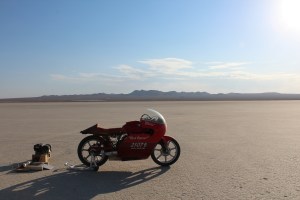
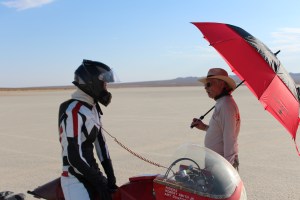
The El Mirage July race event was cancelled last weekend due to excessive heat, but we made lemonade out of that lemon by still having our own testing day. We still woke up early like it was a race to leave by 4:30 AM, getting to the lakebed by 7:00 AM to get as much done as we could before the temperature reached 100 oF. With no technical inspection and waiting in line, I had time to complete five passes, up and back, totaling approximately 10 miles – That’s essentially the total distance covered in a typical El Mirage season. It was also David’s first time at the lakebed!
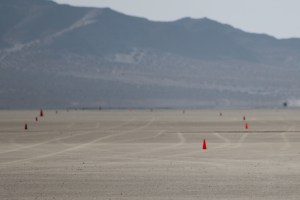
We had the end of lakebed to ourselves and set out a ½-mile track with ½-shutdown. Cones were placed every 1/10-mile and big cones marked the ½-mile “finish line” and 1-mile “back door.”
The goal was to continue the run-in of new engine components (cylinders, rings) and see if I could match Smitty’s acceleration (106 mph in the ½-mile). To make a long story short, the cylinders and rings wore in successfully and I went 104 mph.



Debrief Notes
After five passes there are quite a few takeaways for both the motorcycle and me. Numbers included below for moto-nerds.
Motorcycle
- There were consistently high intake temperatures (160+ oF compared to typical of 130 oF), and no sign of overheating, so that’s good. A few factors were at play:
- The air-fuel mixture was slightly leaner than usual because I was not running at wide-open throttle. That missing fuel would have provided additional cooling to the intake charge.
- The forced cooling used between runs (i.e., leaf blower) did well to cool the cylinders, but it didn’t give much airflow to the supercharger body that sits higher in the fairing.
- The used rear cylinder and rings benefited from using a gas-ported piston which is new for this season. Gas porting increases ring pressure against the cylinder walls, therefore increasing the wear rate of the rings until they perfectly match the cylinder wall. This break-in process is usually difficult to achieve with just 2 miles per race run. The result? The cylinder now holds pressure much better (60 of 80 psi before, 68 of 80 psi after).
- We can consider advancing the ignition timing since the thermal stress didn’t cause any detonation issues (explanation below).
- The engine oil was no more dirty than after a typical race day. This is especially good since it was so much mileage at such high temperatures.
Rider
- Stop over-revving when shifting, which was particularly prone to happen from 3rd to 4th. Two factors were at play here too:
- Physical: The supercharger boosts the pressure of the intake track which tends to slow throttle response when rolling off the throttle during a shift. As a result, I need to roll of the throttle further and earlier relative to the clutch/shifter operation to give the engine more time to slow down.
- Psychological: I need to focus on not rushing the shifts overall, especially in the higher gears. Clean shifts are more important than fast shifts, for the sake of the engine components!
Surprise Data + Analysis
On the return leg of each pass, I went from 25 to 100+ mph in 4th and 5th gear, starting somewhere just over 2000 RPM and pulling up passed 7000 RPM – not something Smitty would normally do. This was interesting data from a performance perspective because it told us that the engine could withstand high intake temperatures (160+ oF) plus full supercharger boost pressure (55 inHg) for an extended amount of time without any sign of pre-detonation.
Pre-detonation backstory: The Red Baron had previously suffered pre-detonation issues during a record-setting run, which resulted in critically high cylinder head temperatures. To mitigate the issue moving forward, the ignition timing was pulled back which stopped the pre-detonation issue but also reduced horsepower. Now, The Red Baron has more ram-air cooling around the cylinder fins and uses higher octane gasoline (C123), reducing the tendency for overheating and pre-detonation. Smitty developed a sneaking suspicion that the pre-detonation may have been caused by another factor: Head gasket sealant that had extruded into the combustion chamber which acted like a glow plug, pre-igniting the air-fuel mixture. Since that run, we weren’t sure if the gasket sealant was really the primary cause.
Since the engine was able to withstand the thermal stress, it essentially confirms that the gasket sealant was the cause of our prior pre-detonation issues. With that knowledge, we can consider advancing the ignition timing again. It’s also time to consider visiting a dyno (again) to really optimize the ignition timing and fueling.
It’s great to know the engine could handle this extended thermal stress, but overall, not a good practice. The low-RPM pulsing, intensified by the supercharger, physically stresses the engine components (connecting rods, bolts, bearings, etc.). Future runs will use more downshifting, around 5000 RPM, so the return leg is started in a lower gear at a higher RPM. This will also reduce the time that the clutch is in while coasting, lessening the time that the clutch plates are whizzing around at very high differential speeds in very close proximity.
Writing this post has also helped me digest the whole thing. Thanks for reading!
Very Good “De-Brief” writeup Miss Amy…… However, I think you are a little hard on yourself as any practice/test section where we learn new facts is always a good one…..
Plus, you had more good shifts than bad….11 perfect vs 9 over speeds.( I counted)
I can’t wait for us to go again.
Smitty
Thanks Smitty 🙂 There were definitely lots of positive takeaways too. Looking forward to next time too!
I love this! thanks for all the geek data (which I really don’t understand but kinda “get”) and the photos!!!
Test day sounded awesome! Loved the pics!