
When turning the crankshaft on an internal combustion engine, you can feel an increase in resistance caused by generating a vacuum or building compression when the valves are closed. This indicates that the piston rings are holding a seal with the cylinder walls.
Smitty noticed that we were not holding compression pressure, particularly in the rear cylinder, when turning the crankshaft by hand. The following procedure and calculation were used to test the severity of our piston ring leakage problem on the rear cylinder…
Static Compression Ratio (SCR) = 9.1:1
The intake valve closes, and compression begins, when the piston is 45-degrees after bottom dead center (ABDC). This timing results in a dynamic compression ratio (DCR) that is approximately 75% of the static compression ratio (SCR).
45-deg / 180-deg stroke = 25% of stroke is not generating compression
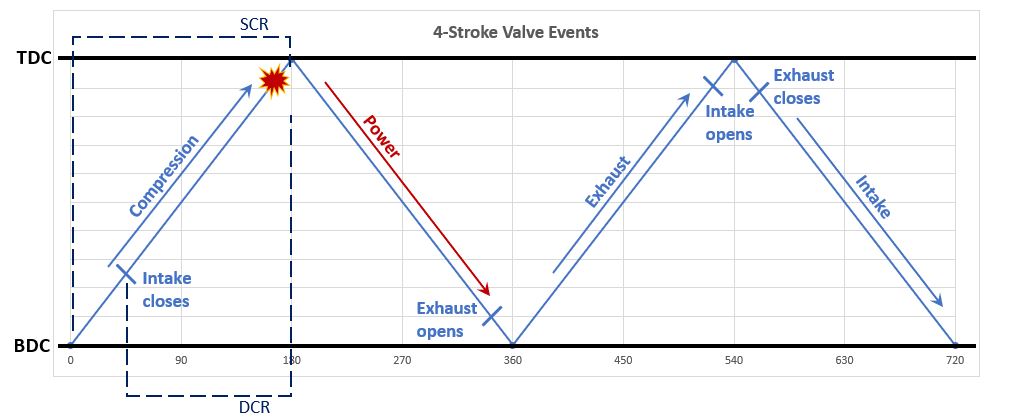
Ideally (without leakage), we should see a maximum cylinder pressure of 111.35 psi when the atmospheric pressure is 14.7 psi (sea-level at UC Irvine).
0.75 * { (9.1 + 1.0) * 14.7 psi } = 111.35 psi
When turning the crankshaft at 450 RPM, we generated a maximum cylinder pressure of 105 psi, or 94% of the “no-leakage” maximum pressure. This indicated that the piston ring pressure leakage was slow and its impact was reduced at higher RPMs. No changes needed!